


AdSolarTech
Description
AdSolarTech is the installer of the biggest Schneider Electric off-grid solar system in the world.
Solar makes sense!
You can cut your electricity bill by generating your own power. Our wide range of solutions will ensure that there is something that will work for you.
SolarTech, situated in Ermelo, was established in September 2013 by Mari-Louise Romijn. Towards the end of 2014 the Company changed its name to AdSolarTech and has since opened an office in Nelspruit. Although a relatively young company, by teaming up with the right people, AdSolarTech can offer experience in designing, installing and monitoring of a wide range of consumer and commercial power technology products and services.
AdSolarTech, prides itself in finding alternative solutions for its customers’ energy needs ensuring they become more independent of the current unpredictable electricity supply and costs, while at the same time, saving money and therefore improving profitability.
AdSolarTech will tailor a solution for their client’s specific needs, transforming their electricity cost from a high variable cost to a lower more predictable cost thereby justifying their financial investment while meeting their energy requirements.
Our projects include simple to advanced installations. We only use top quality products and are the only certified and approved PV systems’ integrator in Mpumalanga for Schneider Electric. We also supply other brands, such as, Fire Fly, Phadox, Afrison, Victron, Delta, Yingli, Sunlight.
SERVICES
AdSolarTech offers a full range of services from planning to installation.
Solar makes sense – You can cut your electricity bill by generating your own power. Our wide range of solutions will ensure that there is something that will work for you.
PLANNING
In-house planning
Specialized electronics engineers and CAD designers
Technical system design for ground mounted and roof top projects
ADVICE
Analysing and choosing suitable location
Technical planning and yield estimation
Providing and leading the due diligence process
Planning and calculation of the construction phases
FINANCING
Providing support in obtaining funding
Setting up and organizing the operating company (SPV)
Business plan with profitability forecast
SUPPLY OF COMPONENTS
We supply a wide range of products from various different manufacturers.
INSTALLATIONS
Installation performed by own experienced highly skilled team
High-quality installation, even within tight time frames
OPERATION & MAINTENACE
Remote monitoring of the output values
Replacement and maintenance
Characteristic measurements
Infrared inspection with high-end infrared instruments
Web-based yields and plant monitoring
Regular inspections and continuous system optimization
OPERATION & MAINTENACE
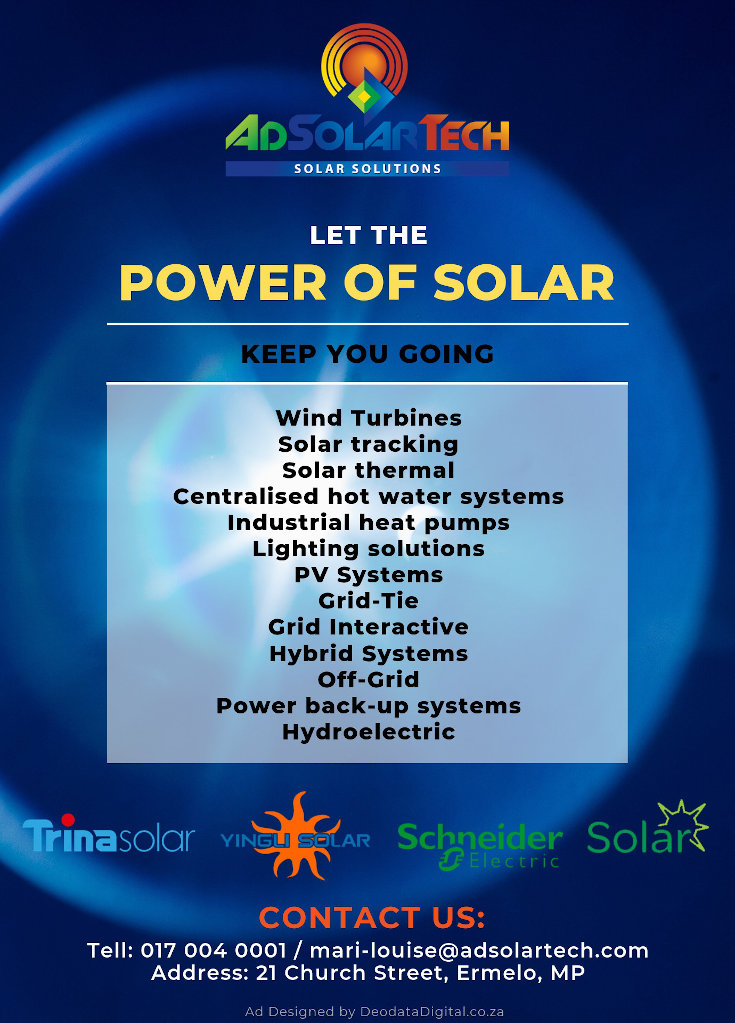
PV Systems
Grid-Tie
Grid Interactive
Hybrid Systems
Off-Grid
Power back-up systems
Hydroelectric
Wind Turbines
Solar tracking
Solar thermal
Centralised hot water systems
Industrial heat pumps
Lighting solutions
What is Solar?
Solar power is the conversion of sunlight into electricity, either directly using photovoltaics (PV), or indirectly using concentrated solar power (CSP). Concentrated solar power systems use lenses or mirrors and tracking systems to focus a large area of sunlight into a small beam. Photovoltaics convert light into an electric currentusing the photovoltaic effect.
Off-grid Energy Solutions
It is possible to install a solar system that is independent of the electrical grid. This is called an off-grid system, and it requires that the solar panels are able to produce enough electricity to cover 100% of the energy needs of the buildling. Most homes have higher electricity demand in the evening or at night, so off-grid systems usually incorporate either a battery (to store energy produced during the day), a backup source of energy (like a generator), or both. Off-grid systems are more complex and less flexible than grid-tied systems.
Off-grid systems are most common in remote locations without utility service. Off-grid solar-electric systems operate independently from the local utility grid to provide electricity to a home, building, boat, or RV (or remote agricultural pumps, gates, traffic signs, etc.). These systems typically require either a battery bank (to store solar electricity for use during nighttime or cloudy weather) a backup source of energy (like a generator), or both. An off-grid solar system must be large enough to produce enough electricity to cover 100% of the energy needs of the buildling. In all off-grid scenarios, electrical usage must be monitored and kept below the maximum output of the panels and batteries as there is no grid-source to supply excess power.
System components:
PV panels
Battery bank
Charge controller (to protect the battery bank from overcharge)
Inverter
Required electrical safety gear (i.e. fuses, breakers, disconnects)
Monitoring system to balance energy consumption with production
Grid-Tie Energy Solutions – quickest return on investment
Grid-tied systems are the most common type of solar PV system. Grid-tied systems are connected to the electrical grid, and allow residents of a building to use solar energy as well as electricity from the grid. Grid-tied systems do not need to produce 100% of the electricty demand for a home or business. When there is no demand for energy, the solar panels send excess electricity back out into the grid for use elsewhere. When a home or business is using energy, but the solar panels aren’t producing enough energy (at night, or on a stormy day), electricity from the grid supplements or replaces electricity from the panels
Living with a grid-tied solar PV system is no different than living with utility electricity, except that some or all of the electricity you use comes from the sun. Grid-tied systems do not provide protection from power outages. When the electrical grid fails, grid-tied systems will not continue to operate. This allows utility employees to fix the power lines safely without wasting time identifying solar energy systems that are still feeding electricity into the power lines.
System components:
PV panels (multiple panels make up an array)
Inverter(s)
Required electrical safety gear (i.e. fuses, breakers, disconnects)
Monitoring system to monitor energy production (optional)
Hybrid Energy Solutions
A hybrid system provides energy in a number of ways creating a very stable and reliable energy source. Using a combination of grid-tie as well as off-grid solutions you are ensured of an uninterrupted power source.
Grid-tied systems can be upgraded to include a battery backup: a bank of deep-cycle batteries. The backup battery is charged by both the grid and the solar panels. In the event of an outage, the backup battery will need to be switched on either manually or with an automatic system to provide backup power to the building.
System components:
PV panels
battery bank
charge controller (to protect the battery bank from overcharge)
inverter
required electrical safety gear (i.e. fuses, breakers, disconnects)
monitoring system to monitor energy production (optional)
DC or Portable Energy Solutions
A DC or portable solution for your basic power needs such as security lights, electric fences, pumps and for camping. This is the simplest of all solar energy solutions. Portable solar energy is a great way to utilize the power of the sun, while on the move!
Video
Location
Contact Information
Author Info
Contact Listings Owner Form
Review
Write a ReviewThere are no reviews yet.
Leave a Review


Soliswatt Solar Energy Tech. Co.,Ltd
- 15910500047
- 16 August 2023


Smithfield Electrical and Solar
- 6 April 2023


ZenSolar
- 011 045 9062
- 5 April 2023


RES
- 083 714 3042
- 5 April 2023